Believer: Dimensions | The Thrash Metal Philharmonic

(1993 – R.E.X. Music/Roadrunner Records)
No, we’re not referring to that “philharmonic” so well-known in the world of Metal, but to another one—one that actually existed and fully lived up to the potential nickname “Thrash Philharmonic,” though in reality it’s just a term we made up. It’s rare to witness such a precise fusion of Thrash Metal and classical/orchestral music, all in one, with nearly perfect timing.
And believe me, I’m not exaggerating when I say that “Dimensions” is that long-lost Thrash Metal gem that perhaps deserved better exposure and a place of honor among the genre’s greatest albums. Unlike other bands with Christian themes in their lyrics, Believer’s approach was more than just taking various influences—lots of heavy riffs, speed—and simply cramming them onto an album to create a classic thrash metal record. Quite the opposite. The genius lay precisely in the originality and finesse of conceiving an album that practically borders on perfection.
Let’s rewind to 1993, a time when grunge and alternative music were beginning to dominate, and all the great things the ’80s had given us were starting to fall apart. The great bands of those years were either falling apart or shifting their musical direction in search of better horizons, not always hitting the mark when it came to making a good album. Against this backdrop, where plaid shirts and shorts were all the rage, Believer dared to release a work that went beyond what Thrash Metal was capable of.

Believer is generally classified among the ranks of technical or progressive Thrash bands, which, to be honest, doesn’t do full justice to the full scope of what the band set out to achieve or to the concept behind “Dimensions,”—the album in question, which would become the pinnacle of everything Believer set out to accomplish, managing to create a body of work that’s very difficult to match.
But this story has another side to it. “Dimensions” is only Believer’s third album, and getting to this point involved a long journey. It began in the mid-1980s with a band called “Deceiver,” which later changed its name to Believer. A first demo in 1987, followed by two tremendous albums—1989’s “Extraction From Mortality” and 1990’s “Sanity Obscure”—shaped the band’s sound until it reached total ecstasy on “Dimensions.”
In fact, Believer’s debut with “Extraction From Mortality” was full-throttle, old-school thrash metal—raw and fast— before maturing their musical vision with the excellent “Sanity Obscure”, where the idea of combining orchestral and incidental music with the fury of thrash was already evident—a concept the band would fully develop across the entire spectrum of “Dimensions”.
For the recording of this album, Believer had the opportunity to release it under the well-known Roadrunner Records label—the place everyone wanted to be in those years—and for which they took a huge gamble. The opportunity to record for that label, combined with the allocated budget, gave Believer the time and equipment needed to create a true gem; we believe it was worth it, and “Dimensions” began to take shape right from its initial conception.
The road to this album wasn’t without its challenges, stemming mainly from the vision the band had set for itself, since creating something like this was no easy feat back then. “Dimensions” required several months of studio work from the band, involving an enormous number of tracks—including the famous 48 violin tracks. That fact alone shows that we’re dealing with one of the finest works White Metal has ever produced, but we must also take into account (if you’ll pardon the pun) the extravagant use of various instruments such as cellos, the aforementioned violins, and the soprano vocals of Julianne Laird, as well as William Keller, who serves as the narrator in a fully conceptual story based on very interesting biblical themes that go beyond the typical clichés of Christian bands.
The album possesses a compositional, conceptual, and musical unity that binds all the parts into one, yet there are clearly two distinct sections. The first runs from the opening track (“Gone”) through the sixth (“No Apology”), before moving into what Believer dubbed the “Trilogy of Knowledge”—a true multi-part classic that contains the album’s finest moments—but let’s take it step by step.
It is precisely “Gone” that opens the door to “Dimensions”; relentless, with shifting tempos and intricate riffs, one could say that here we have the classic Believer, but under a different concept than what we might have come to expect, especially in terms of sound and compositional structures.

We see Believer’s use of the recording studio’s resources and the technology available at the time fully realized in “Future Mind,” which suits them perfectly. Here, Believer really pushes the tempo and blast beats as far as their own vision of technical thrash metal allows, while still thoughtfully crafting every last riff and chord—not to mention the guitar solo. It’s truly mind-blowing.
Another standout aspect of this album is the versatility Believer demonstrated in creating true, timeless gems—such as “Dimentia,” a track that shakes you to the very depths of your soul. A song that delves into philosophical questions—Sartre, Feuerbach, Freud, and others—with the question shouted as a battle cry, “Where is the Wise Man?”, making it one of the best tracks on the album and in Believer’s entire discography. The violins and cellos taking center stage offer a preview of what’s to come, but before we get to that part, there’s more.
And that “more” is embodied in “What Is But Cannot Not Be,” which, amid so much musical beauty and decay, doesn’t shine as brightly as it should, though it has what it takes to keep the album’s momentum from flagging, holding its own within the album’s overall quality, but we also find “Singularity,” a throwback to their early days when old-school thrash metal abounded without so many progressive elements—it was more of a straight-ahead, no-nonsense approach—while still incorporating philosophical themes and reflections in its lyrics.
Before moving on to the best of “Dimensions,” Believer takes us through “No Apology,” another must-hear gem on this album. With a relentless drive and classic twisted riffs, here Believer experiments with different rhythms, varying tempos, and harmonies that might seem unthinkable for a band of this caliber.

What follows is truly the icing on the cake. The reason “Dimensions” is Believer’s masterpiece. We’re talking about “Trilogy of Knowledge,” a sort of symphonic work divided into three parts (actually four), in which Believer takes their tendency to combine classical and symphonic music with thrash metal to its highest expression, in a supreme effort both compositionally and in terms of production. We’d already seen some of this on their previous album, “Sanity Obscure,” but it’s here that Believer gives free rein to their creativity and genius.
“Trilogy of Knowledge” is simply a way of exploring certain concepts—such as lies, truth, and knowledge—from philosophical and biblical perspectives in a single piece divided into three distinct parts. Actually, four, since the introduction to all of this is the interlude “The Birth,” which opens the door to this true work of art.
The first part is titled “The Lie,” where deception is presented as a form of distortion of reality, centering this concept on the well-known story of Adam and Eve with the serpent. The track in question is a magnificent display of virtuosity, with cellos and violins taking the lead, and Believer’s heavy rhythm section accompanying and driving from behind, combining the soprano vocals of Julianne Laird with the gravelly vocals of Kurt Bachman.
In the second part, titled “The Truth,” one concept is contrasted with the other, featuring the story of Christ’s temptation in the desert. It successfully creates an atmosphere that truly captures the circumstances described and the story itself, with a track where the cellos and violins take center stage alongside string arrangements specially prepared for the occasion, before Believer strikes with all its classic, overwhelming power, subsequently taking us to one of the pinnacles of their creativity and genius. A true gem.
We still have the final part, or rather “The Key,” which, in a much more operatic and classical tone, takes us into much more contemporary territory from a lyrical standpoint, contrasting light with darkness as the trilogy continues to unfold. And here this story ends—not only that of “Trilogy of Knowledge” but also of “Dimensions” as an album—though not before the band bids farewell with “We Love You. Take Care. Bye Bye,” as a final corollary.

Without a doubt, “Dimensions” marked the culmination of Believer’s entire body of work. Beyond the band’s ups and downs, and how complicated it was to produce and record this entire masterpiece, the truth is that the album is a legend in its own right and a symbol of the band, as over time it became Believer’s defining album and a must-listen for anyone wishing to delve deeper into Christian Thrash Metal.
And in fact, there’s one aspect that really raises the stakes. Believer doesn’t follow the typical path of so-called “White Metal,” nor does it embrace the more traditional message. It delves deeply into philosophical, scientific, and even theological themes. A true work of art, both musically and lyrically, achieving a depth rarely seen—even within the Thrash Metal genre itself, which is accustomed to a different style of lyrics.
After “Dimensions,” Believer went on hiatus, from which they wouldn’t return until well into the 21st century, releasing two new albums between 2009 and 2011 (“Gabriel” and “Transhuman”), but they would never again reach the level achieved here—a difficult task, to say the least.
The band’s current status is unknown. A few singles released digitally in 2017 seemed to hint at something new, but so far, nothing at all. A total mystery.

We’re left with “Dimensions,” an album that set out to do something different within the thrash metal genre. Not only did it succeed, but it also left its mark on history. Today, it’s a cult classic and a clear example of what can be achieved when creativity, musical genius, and a clear vision come together.
We’ve already mentioned how difficult and complicated the production and recording process was at “Trauma” Studios, where “Dimensions” was created, but we must acknowledge that the resulting sound is truly superb. The mixing wasn’t going to be easy, especially with so many tracks of cellos and violins, plus the overwhelming force that is Believer, with their diverse guitar sounds—which, through relentless pounding, give the sound that raw edge so characteristic of the band. But there’s also a whole world of different, digitized sounds, playing with technology that was still in its infancy back then. All of that came together in an almost perfect mix and mastering, which gave “Dimensions” a clean sound with a wide, amplified spectrum—powerful and unlike anything heard before. It’s one of the most notable characteristics, and it’s worth highlighting.
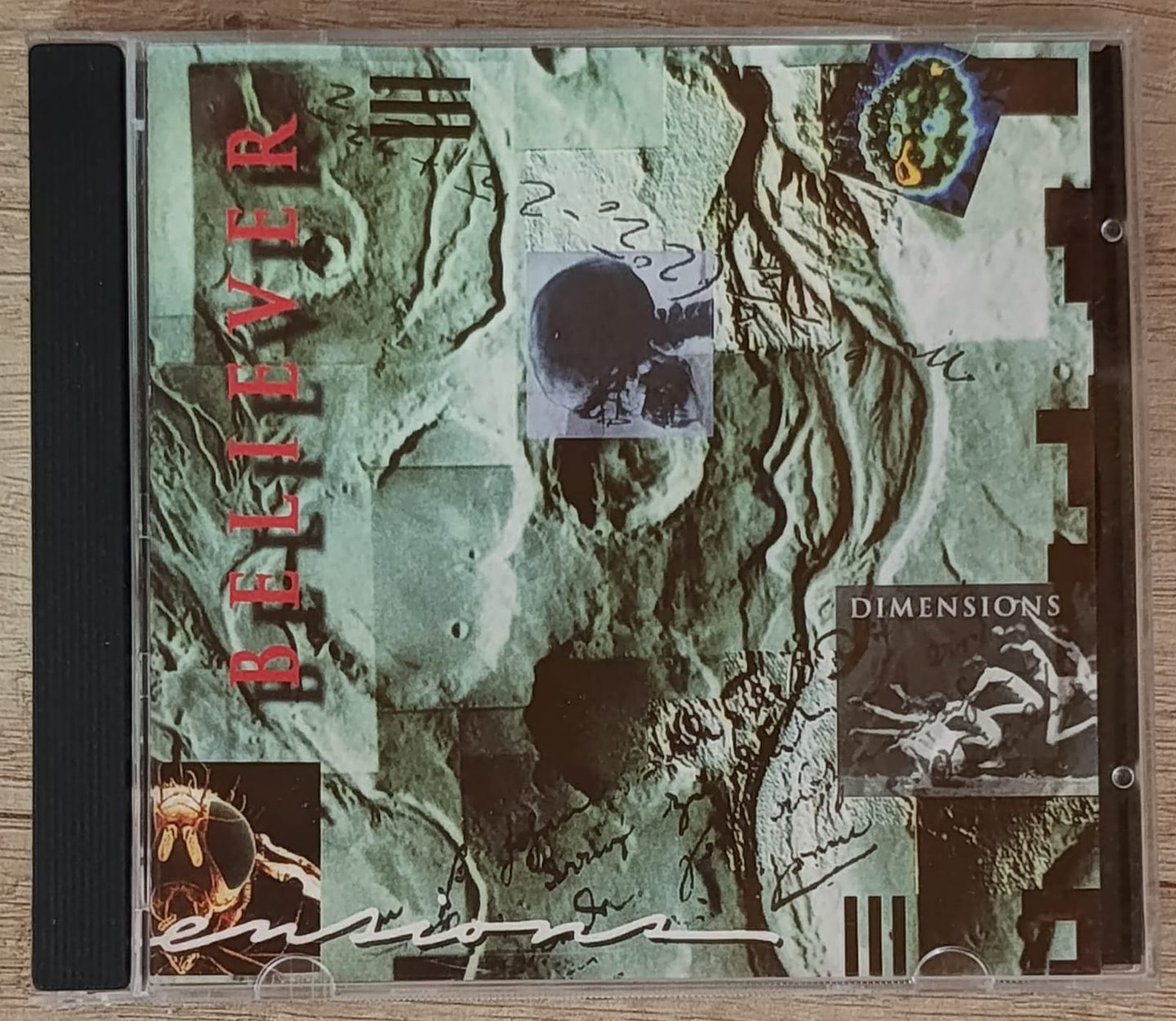
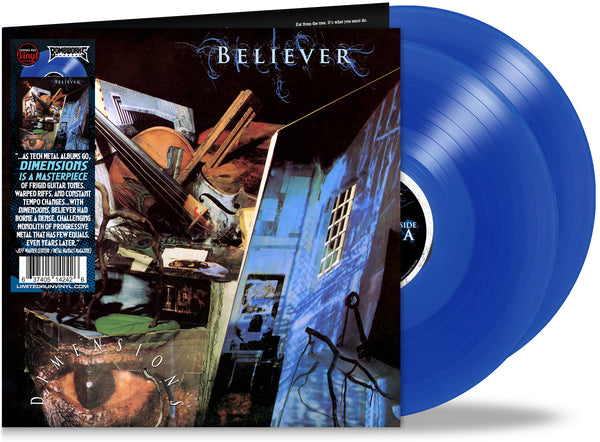
As for the artwork and the different editions, the matter is a bit complex. First of all, it’s important to note that the album has two main versions, which differ completely in their artwork—to the point of having different covers and, consequently, different interior layouts.
The Roadrunner Records cover seems to be the most memorable—or perhaps the one most closely associated with Dimensions—and indeed, subsequent reissues feature precisely that artwork, by Dave McKean, as the album cover. The alternative cover is the one that appeared on the R.E.X. Music version of the album, which, as you can see, is completely different.
There are internal differences as well; while both inner sleeves include all the lyrics, the R.E.X. Music version appears to have been designed with greater care.
Where they do not differ is in the musical content, since the album is ultimately the same, except perhaps for the closing greeting, which on the Roadrunner version is a separate track from the rest. Nothing more than that.
As expected, over time “Dimensions” went out of print, but don’t worry—it has been made available to the public again as a reissue, both by Retroactive Records and Bombworks Records, even including some live bonus tracks. It has also been reissued as a double vinyl set, which gives you yet another reason to check out one of the great albums of experimental, technical, and progressive Thrash Metal.

“Dimensions” represents the pinnacle of Believer, an underrated and overlooked band in the history of thrash metal. Perhaps because of its Christian identity, it never received the wider recognition it truly deserved at the time. The new waves emerging in the ’90s may also have been a factor in why more attention wasn’t paid to an album that swept away everything that had been known up to that point.
Believer knew how to blend precision, technical skill, and experimentation with Thrash Metal—a genre they never renounced and from which they never strayed. The fusion of orchestral elements, classical music, and operatic influences on “Dimensions” reached truly sublime heights, which is why we wanted to commemorate it. To take a journey through an album that’s worth remembering and always keeping in mind.
What Believer never did was release a music video for any track from this great album, nor are there any live video recordings from that era—at least not that we’re aware of. All we can do is remember “Dimensions” playing on our stereo, loud and clear, as it should be…