Theoptia: Undead Gods | Simple And Effective
(2021/2022 – Unblack)
Emanuel Strobel and his project Theoptia had already been featured on this webzine, specifically with their first official album, “Horeb”, a conceptual work for which we shared and published our review. Now it’s time to listen to Theoptia’s next album, “Undead Gods”, a new conceptual project centered around a different theme than that of the first album.
And that is the first major difference we can highlight between “Horeb” and “Undead Gods”—namely, the central theme around which the included tracks revolve. This time, the various false gods of the Old Testament will take center stage, and several of them will serve as the main characters in each of the songs on the album.
Another noteworthy detail is that on “Undead Gods”, while Strobel remains the sole permanent member of the project and is responsible for almost everything in Theoptia, this time he chose to feature some guest musicians on the album, which adds a bit more versatility and musical richness to the project. Namely: Simon Frederik Piringer and Taanak from Demoniniduth on vocals, Peter Watson from Watson Conspiracy and Wolfgang Nillies from Sacrificium on guitars, and Raphael Brunner on drums—though in the latter case, his participation extends throughout the entire album.
That’s not the only difference. Looking at the album itself, it’s clear that “Undead Gods” possesses a much tighter cohesion and is perhaps not as experimental as “Horeb” was. There’s a slight shift toward a much more tribal sound, closer to metalcore, while still maintaining a foundation in technical and progressive death metal, with hints of Eastern music in some of its melodies and harmonies.
Simplicity seems to be the leitmotif of “Undead Gods”, and straightforwardness in composition and arrangement are the cornerstones of this new work.
“Molech” is the album’s opening track, and in a way, it welcomes us with a preview of the changes we’ve been discussing. With a dry, cutting riff and a mid-tempo foundation, Theoptia moves a bit closer to a compositional style more in line with current trends—one might say—with a certain metalcore aesthetic, more precisely, and a tribal feel, as we mentioned earlier.
By the time we reach “Dionysos”, that stylistic shift becomes much more pronounced, and with its melodic lines in the chords and riffs, it allows us to speak of a different Theoptia. Here we see the appearance of the first guest artist: specifically, Simon Frederik Piringer on vocals.
Next, “Nehustan” presents a heavy, pounding rhythm section with a certain atmospheric intent in its conception, yet it goes on the offensive time and again with super-fast riffs; however, “Mammon” is perhaps the missing link between Theoptia’s first album and the one at hand. Thanks to this track, we can see that the experimental element hasn’t been entirely lost after all. Here, it’s Wolfgang Nillies who takes the guitar to give it a distinct sound and a solo that truly takes Theoptia’s sound and approach to new heights.
“Ashtaroth” presents something quite complex from a compositional standpoint, shifting through various moods throughout the song; with the combination of Strobel’s vocals alongside Taanak’s, it embodies much of the creative and experimental side to which Theoptia is so inclined, though maintaining a certain logic that oscillates—as on most of the album—between technical, progressive Death Metal and a certain inclination toward something simpler, more direct, and more in line with modern trends, albeit with occasional nods to blast beats that inevitably draw closer to Black Metal.
“Gaia” appears here, showcasing another facet of this version of Theoptia that leans more toward something more concrete and modern, so to speak, while “Adonis” is built on strong, dry, cutting riffs at just the right speed, revealing a track that is, in a way, grandiose from its very conception and climactic without having to resort to too many breakdowns.
The album closes with “Baal”, a track that definitely strays from what we’ve come to expect from Theoptia but still suits them very well. The guitars on this track were handled by Peter Watson, who delivers a “fast and furious” solo with many notes played almost simultaneously. The vibe reminded us of Mortification in their final phase as a band, though it maintains a prudent distance.
The experimental and progressive side that Theoptia had shown on “Horeb” has, here, sort of fallen by the wayside. Instead of experimenting with different facets and sounds, Strobel opted for a much more concrete and direct approach, placing heavy emphasis on hard, cutting rhythms, with much drier harmonic lines and without as much mystical flight in the music.
The result is much more appealing and accessible to the casual listener of extreme music. This simplicity spares Theoptia from having to beat around the bush or explore various musical avenues, though it’s also true that much of the progressive spirit that “Horeb” had successfully conveyed has been lost.
In any case, “Undead Gods” shows a different side of the same coin. More simplistic and less cumbersome, yet—in our opinion—much more effective, and this must definitely be considered alongside the stellar guest appearances that have greatly enriched Theoptia’s sound and style.
The sound design has also played a fundamental role here; it feels completely different, with a mix that’s much more natural and less artificial. There are no overloaded sounds or background orchestrations. Furthermore, the instrumentation is basic, simple, and to the point. You could say there isn’t as much experimentation in the studio.
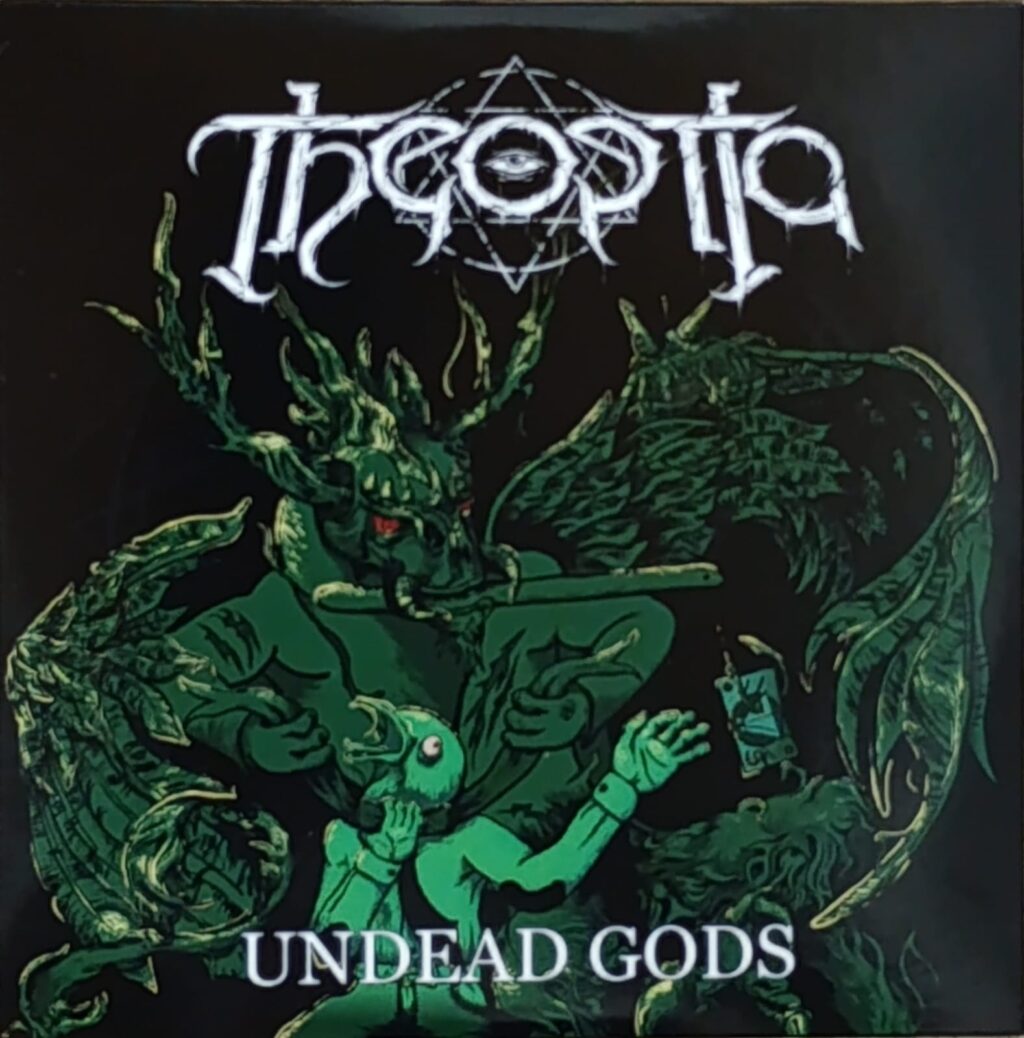
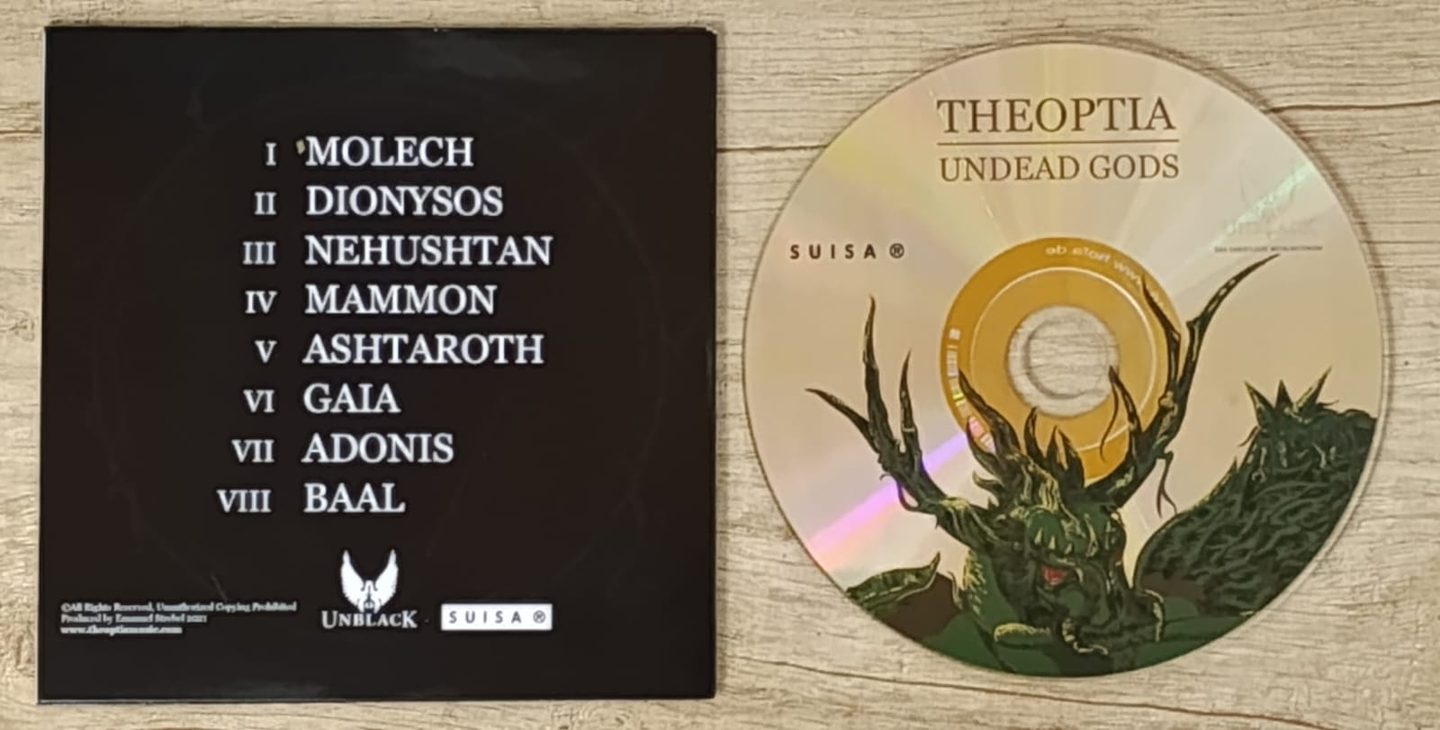
The cover art isn’t overly elaborate nor does it add much, featuring an illustration that’s little more than a somewhat descriptive drawing—the kind that leaves room for the imagination and plenty of interpretation. The physical release of “Undead Gods” follows the same approach as the previous work, consisting simply of a cardboard box set without a booklet—more akin to the promotional or press releases of yesteryear. Of course, it’s still appreciated to have a physical album, which is also available on vinyl. Good for Theoptia—despite being a completely independent project, it still makes an effort to offer us something in physical format.
Theoptia showed us two different sides, both on “Horeb” and on this “Undead Gods.” Ultimately, it comes down to personal taste, though it’s worth noting that in the latter case, we found the result to be much more effective and concrete. What will be the next step for Emmanuel Strobel and his project? It’s impossible to know at this point. What is clear, however, is that Theoptia has plenty of compelling reasons to keep building and growing. They have all the tools they need, and we’re certainly looking forward to more.
Below, we’ve included the album’s first track, “Molech”, as well as Theoptia’s social media links so you can follow the project closely and stay up to date on their latest news, plus a direct link to purchase this album in physical format…
https://www.nordicmission.net/products/theoptia-undead-gods-cd
https://www.facebook.com/theoptiamusic
https://www.instagram.com/theoptiamusic